
Acoustic Phone Booth Specs and Certification Checklist
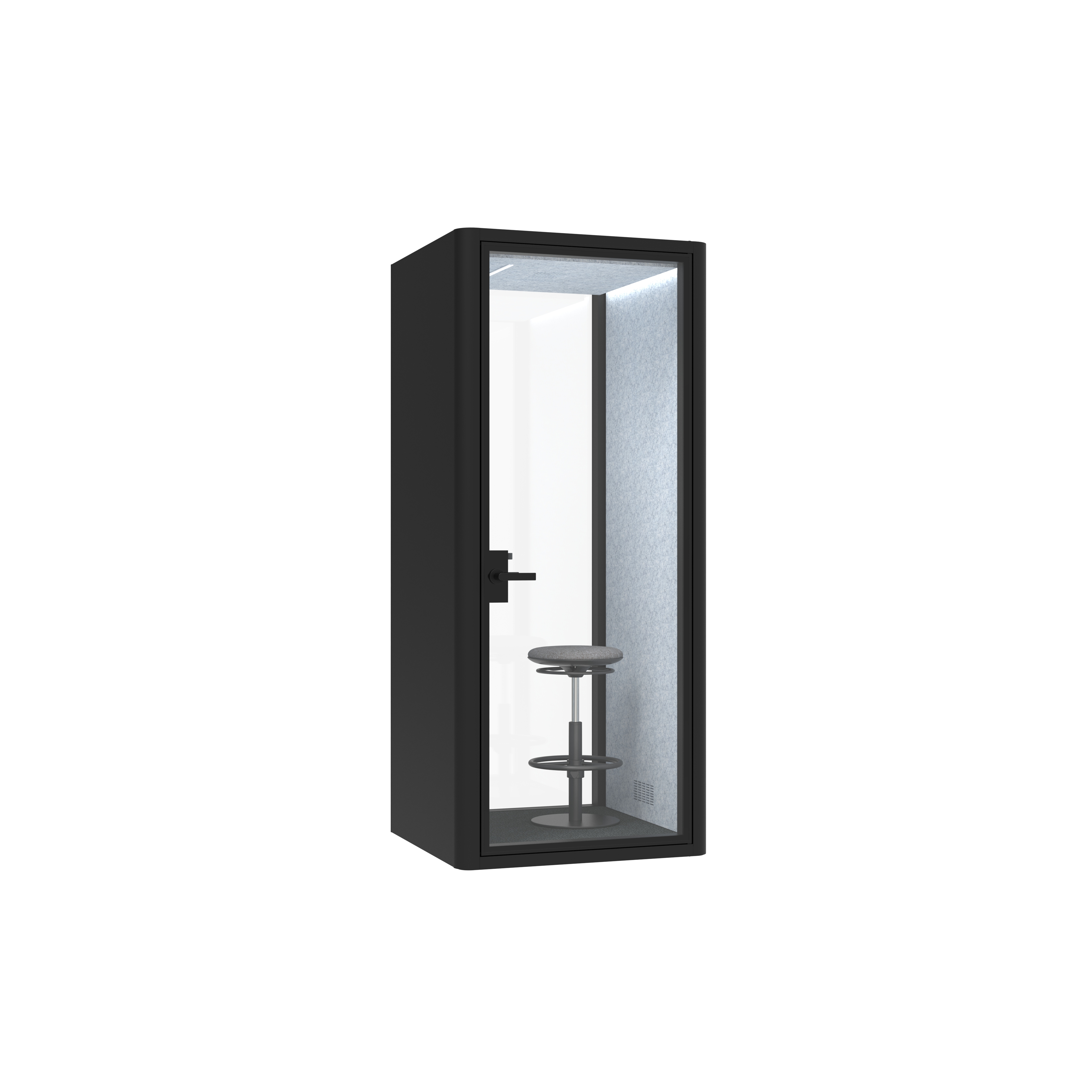
MO BOX - Phone: a single-person acoustic phone booth for private calls and video meetings in open-plan offices. Image: UVO Acoustic Pods.
An acoustic phone booth is a freestanding, enclosed workspace placed inside an open-plan floor so that one or two people can take calls, join video meetings or do focused work without being overheard. The buying decision does not hinge on how the pod looks. It hinges on four constraints that can be written into a specification and checked against a document: the stated sound insulation class, the wall and glazing build-up, the ventilation rate per fan, and the certifications that actually cover the destination market.
UVO Acoustic Pods (HongKong UVO international group Co.,LTD, founded in Hong Kong in 2017) builds the MO BOX, Q ROOM and R POD ranges on one construction system: an aluminium alloy frame, a steel ceiling base and steel exterior wall panels, 11 mm laminated glass surfaces, and a 25 mm five-layer acoustic interior wall. Sound insulation is stated as Class A or Class B depending on the model, and ventilation is rated at 90 m³/h per fan, with the fan count set by model size.
Those four data points — class, build-up, airflow, certification — are what a buyer at the research and evaluation stage can actually verify. Everything else is preference.
Why phone booth specifications break down during evaluation
Most procurement problems with acoustic pods are not manufacturing failures. They are specification failures, and they appear in three predictable places.
1. Acoustic numbers that cannot be compared
Suppliers publish acoustic claims using different measurement bases. Some report ambient-noise reduction; others report speech level reduction under ISO 23351-1. Public supplier pages in this category show the confusion directly: one European supplier reports model values between 28.7 dB and 31.1 dB, and the same supplier's pages use both ambient-noise wording and ISO speech-level-reduction wording. Without the underlying laboratory report, those numbers cannot be ranked against each other, and they should not be averaged.
The definition to hold every supplier to is ISO 23351-1:2020, which describes acoustic performance in terms of speech level reduction (DS,A), with Class A requiring 30 dB or more. If a supplier quotes a class, ask for the model-level report behind it. If a supplier quotes only decibels, ask which metric and which test set-up produced them.
2. Ventilation treated as a footnote
A pod that seals well but ventilates badly becomes a room people avoid. It is a maintenance and utilisation issue rather than an acoustic one, and it is invisible in a spec sheet that lists only glass thickness.
UVO's own troubleshooting documentation treats a stuffy cabin as a diagnosable fault with defined causes: blocked intake and exhaust vents, dust or carpet-fibre build-up, poor fan performance, or a sensor switch that fails to start the fan when the cabin is occupied. The same documentation distinguishes a single affected compartment (a localised fault) from multiple affected compartments (an installation or environmental issue). That distinction only exists because airflow is a specified, calculated quantity — not a feature.
3. Certifications read as one badge
Certification marks are frequently treated as a single pass/fail signal. In practice each mark covers a defined scope. On the UVO ranges, CE covers electrical safety, SGS NA covers electrical safety for the Canadian market, GREENGUARD covers chemical emissions of interior materials, and ISO 9001 and ISO 14001 cover quality and environmental management systems. None of these marks certifies acoustic performance. Acoustic performance is a separate, model-level statement.
4. Installation tolerance written out of the contract
Sound insulation is compromised most often by an incompletely closed or misaligned door, or by a missing top cabin mounting bracket. UVO's field guidance is specific: the booth must be level with the floor, uprights must be plumb to the ground, a laser level is recommended at installation, and a simple light-leak test should be run on a closed door before handover. If installation quality is not in the contract, the acoustic specification is not enforceable.
Where the acoustic pod market stands in 2026
The global office pods market is expected to reach USD 1.00 billion in 2026, according to Mordor Intelligence. Europe held a 66.4% revenue share of that market in 2025 according to Straits Research, while Asia-Pacific is described by Mordor Intelligence as the fastest-growing region, with a 43% share of global soundproof booth installations. Research providers define the category differently — office pods, soundproof booths and industrial acoustic enclosures are not identical scopes — so headline market figures should be read per source rather than blended.
Two practical consequences follow for anyone evaluating a booth in 2026.
First, specification language is converging. European projects tend to arrive with a class requirement and a documentation request already written in; Asia-Pacific projects increasingly do the same, because the manufacturing base serving both regions is the same. A supplier that cannot produce a model-level acoustic statement and a valid certificate will lose those tenders regardless of price.
Second, certificate validity dates matter more than certificate logos. A certificate expiring during a project's installation window creates re-verification work, and in a multi-site rollout it creates a documentation gap per site.
What UVO Acoustic Pods specifies, and why each element is checkable
UVO's pod construction is deliberately repetitive across the range. That repetition is the point: a single-person acoustic phone booth and a six-person acoustic meeting booth share the same wall logic, so a buyer who validates one configuration has effectively validated the family.
Construction build-up
- Frame: aluminium alloy frame structure.
- Ceiling and exterior skin: steel ceiling base and steel exterior wall panels.
- Glazing: 11 mm laminated glass surfaces.
- Acoustic interior wall: 25 mm five-layer acoustic construction.
- Configuration concept: room-in-room — a self-supporting module that carries its own lighting, power and airflow rather than depending on the base building.
The glass and the interior wall do different jobs. The 11 mm laminated glass provides mass and damping at the view surface, where solid panels are not acceptable; the 25 mm five-layer acoustic interior wall handles absorption and transmission on the non-glazed faces. A supplier that can state both thicknesses and the layer count is describing a build-up; a supplier that states only "soundproof glass" is describing an intention.
Ventilation
Each fan provides 90 m³/h. The number of fans is set by model size: one fan on MO BOX - Phone, two fans on MO BOX - Solo, Q ROOM - 3XS, Q ROOM - 2XS, MO BOX - Chat, MO BOX - Live and R POD - Mini/Middle, four fans on MO BOX - Talk, MO BOX - Cowork, Q ROOM - XS, Q ROOM - S and R POD - Large, six fans on MO BOX - Meeting, MO BOX - Meeting plus, MO BOX - Meeting BF and MO BOX - Conference, and eight fans on Q ROOM - M and Q ROOM - M BF.
The arithmetic is therefore transparent: a six-fan configuration delivers 540 m³/h, an eight-fan configuration 720 m³/h. A buyer can size ventilation against occupancy instead of accepting it as a fixed feature. It also gives maintenance a measurable baseline — if a cabin starts to feel stuffy, the first check is whether the specified airflow is still being delivered.

The single-person acoustic phone booth format: aluminium frame, 11 mm laminated glass, 25 mm five-layer acoustic interior wall, one ventilation fan rated at 90 m³/h.
Acoustic rating
Sound insulation is stated as Class A or Class B by model. MO BOX - Solo and Q ROOM - 3XS are the Class A single-person configurations on the current list, with Q ROOM - 3XS specified at 30.2 dB. The remaining models in the MO BOX, Q ROOM and R POD families are specified as Class B, or do not state a class in the published specification and should be quoted on request.
This is where the ISO 23351-1 distinction becomes useful in a tender. Class A under that standard begins at 30 dB of speech level reduction. A buyer who needs a booth for confidential calls and video meetings should decide the class first, then choose the model that meets it, rather than choosing a model and accepting whatever class it happens to carry.
Services and installation conditions
Pods are plug-and-play units with matched equipment for lighting, power, USB, Type-C and a fresh air system. Operating conditions are indoor normal ambient, or outdoor environments protected from rain. Installation height must be above 2400 mm.
That last figure is easy to overlook and expensive to discover late. It should be checked against ceiling height, sprinkler positions and any raised-floor build-up before the purchase order is issued.
Certifications: what is covered, for which market, until when
Certification is the constraint most often summarised incorrectly in a comparison spreadsheet. The table below lists the current certificates exactly as scoped, including validity dates.
| Certification | Issuer | Certificate number | Standard cited | Market | Valid until |
|---|---|---|---|---|---|
| CE — electrical safety | UDEM | M.2025.206.C119277 | EN 62368, EN 50032, EN 60100-3-2, EN 60100-3-3 | EU | 2030-04-17 |
| SGS NA — safety compliance | SGS | SGSNA/26/GZ/00129 | CAN/CSA C22.2 No. 61010-1 3rd Ed | Canada | 2027-04-17 |
| GREENGUARD — environmental | UL | 354320-410 / 354321-410 / 354322-410 | UL 2821 | North America | 2027-04-17 |
| ISO 9001 and ISO 14001 | Dual certification | — | Quality and environmental management systems | — | — |
The CE certificate scope covers the Phone, Solo, Relax, Cowork, Talk, Talk Plus, Meeting, Meeting Plus, Conference, Mini, 3XS, 2XS, XS, S and M models. The SGS NA scope covers Phone, Solo, Relax, Chat, Live, Cowork, Talk, Meeting, 3XS, 2XS, XS, Mini, Middle and Large. The GREENGUARD scope covers Phone, Solo, Relax, Chat, Live, Cowork, Talk, Meeting, 3XS, 2XS, XS, Mini, Middle and Large, and documents the chemical emissions of the interior materials used in those pods under UL 2821.
CE electrical safety certificate M.2025.206.C119277, issued by UDEM, valid to 2030-04-17.
A six-step specification and verification sequence
The sequence below is the order in which the constraints actually bind. Changing the order usually means re-quoting.
- Define the acoustic target by use. Confidential calls and video meetings set a different bar from focused work. Fix Class A or Class B before looking at models, and require the model-level acoustic statement in writing.
- Size the pod by occupancy, not by floor space. One person for calls and video; two people for interviews and one-to-ones; four to six for collaborative meetings. UVO's single-person acoustic pod configurations include MO BOX - Phone, MO BOX - Solo, Q ROOM - 3XS and R POD - Mini; two-person configurations include MO BOX - Talk, MO BOX - Chat, Q ROOM - 2XS and R POD - Middle; multi-person configurations include MO BOX - Conference, MO BOX - Meeting and Q ROOM - M.
- Check the airflow arithmetic. Multiply fans by 90 m³/h and compare the result with the occupancy you intended. This is the single number that prevents a stuffy cabin six months after handover.
- Verify the build-up in writing. Aluminium alloy frame, steel ceiling base, steel exterior wall panels, 11 mm laminated glass, 25 mm five-layer acoustic interior wall. If any element is described only in adjectives, ask for the thickness.
- Map certificates to the destination market and to the calendar. CE for the EU, SGS NA for Canada, GREENGUARD for North America. Check that the model is in scope and that the validity date survives the installation schedule.
- Fix commercial and service terms. MOQ is 1 unit; standard lead time is 3–4 weeks and customized lead time is 5–6 weeks; production capacity is 500–600 units per month; every unit is 100% tested. After-sales support covers an installation manual, an installation video, remote technical support and on-site guidance. Add the 2400 mm installation height, floor level and plumb requirements to the site-readiness checklist.
Configurations by use case
Because the construction is shared, model choice is mostly about occupancy, acoustic class and airflow — not about build quality.
Private calls and video meetings
The acoustic phone booth format is the highest-turnover unit on most floors and should be specified for speech privacy first. MO BOX - Phone is a single-fan, Class B private call and video conferencing booth; Q ROOM - 3XS is a two-fan, Class A video meeting and quiet workplace booth specified at 30.2 dB; MO BOX - Solo is a two-fan, Class A unit configured for video meetings, private calls, manager rooms and live rooms.
Interviews, one-to-ones and negotiation
MO BOX - Talk is a four-fan, Class B two-person meeting, collaboration and interview room. Q ROOM - 2XS is a two-fan, Class B two-person meeting and interview room. MO BOX - Chat is a two-fan, Class B negotiation and interview room.
Small group collaboration
MO BOX - Conference is a six-fan unit built around a 4–6 person meeting room. MO BOX - Meeting is a six-fan, Class B meeting, collaboration and brainstorming room. Q ROOM - M is an eight-fan, Class B small meeting and brainstorming room.
Barrier-free access
MO BOX - Meeting BF is a six-fan barrier-free office configuration; Q ROOM - M BF is an eight-fan, Class B barrier-free meeting room suited to four people. Both belong on any floor plan that has to meet accessibility requirements, and both should be specified at the planning stage rather than retrofitted.
Open-plan and coworking deployments
UVO reports three reference deployments. A 60-unit MO BOX - Phone installation in Russia, delivered over six months for an open office, is described by the company as delivering effective noise isolation and improved staff work efficiency, with the highlights being quick installation, movability, a compact footprint and adaptability to changing space use. A 15-unit Q ROOM - 3XS deployment in Malaysia, in service for one year, is described in terms of good sound insulation, quick installation and plug-and-play operation. A 10-unit MO BOX - Solo and MO BOX - Talk deployment in China, in service for one year, is described as a quiet, private workspace free from interruptions for an open-plan office.
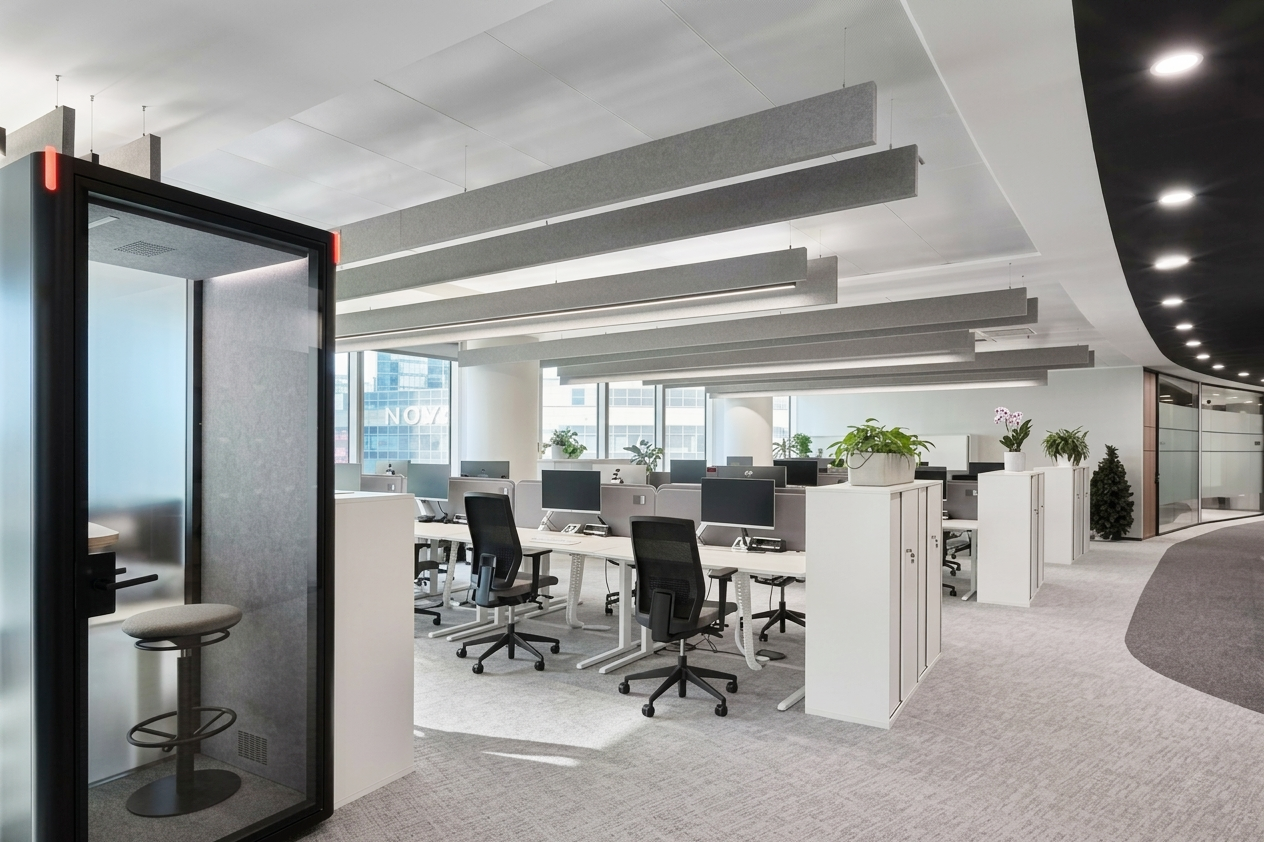
MO BOX - Phone units in an open-plan office deployment.
Comparison: model specification matrix and public reference points
The first table is a specification matrix drawn from UVO product data. It is the table to send to a procurement team, because every cell can be traced to a stated specification rather than to a marketing claim.
| Model | Typical use | Sound insulation | Fans | Ventilation |
|---|---|---|---|---|
| MO BOX - Phone | Private call and video conferencing booth | Class B | 1 | 90 m³/h |
| Q ROOM - 3XS | Video meeting and quiet workplace booth | Class A, 30.2 dB | 2 | 180 m³/h |
| MO BOX - Solo | Video meeting, private call, manager room, live room | Class A | 2 | 180 m³/h |
| R POD - Mini | One-person pod | Not stated | 2 | 180 m³/h |
| MO BOX - Chat | Negotiation and interview room | Class B | 2 | 180 m³/h |
| MO BOX - Live | Manager room and live room | Class B | 2 | 180 m³/h |
| Q ROOM - 2XS | Two-person meeting and interview room | Class B | 2 | 180 m³/h |
| R POD - Middle | Two-person meeting room | Not stated | 2 | 180 m³/h |
| MO BOX - Talk | Two-person meeting, collaboration and interview | Class B | 4 | 360 m³/h |
| MO BOX - Cowork | Negotiation and collaboration room | Class B | 4 | 360 m³/h |
| Q ROOM - XS | Collaboration room | Class B | 4 | 360 m³/h |
| Q ROOM - S | Two-to-four-person meeting and negotiation | Class B | 4 | 360 m³/h |
| R POD - Large | Two-to-four-person pod | Not stated | 4 | 360 m³/h |
| MO BOX - Meeting | Meeting, collaboration and brainstorming | Class B | 6 | 540 m³/h |
| MO BOX - Meeting plus | Small meeting and collaboration | Not stated | 6 | 540 m³/h |
| MO BOX - Meeting BF | Barrier-free office configuration | Not stated | 6 | 540 m³/h |
| MO BOX - Conference | Four-to-six-person meeting room | Not stated | 6 | 540 m³/h |
| Q ROOM - M | Small meeting and brainstorming | Class B | 8 | 720 m³/h |
| Q ROOM - M BF | Barrier-free four-person meeting room | Class B | 8 | 720 m³/h |
The second table lists public reference points that exist outside UVO's own documentation. It is included because a buyer needs a budget anchor and a sense of how the category states its acoustic claims — not because the values are comparable to each other.
| Reference point | Source and year | Published value | What it does and does not tell you |
|---|---|---|---|
| ISO 23351-1:2020 acoustic classification threshold | International Organization for Standardization, 2020 | Class A = 30 dB or more speech level reduction | Defines how a class claim should be expressed; does not certify any individual product |
| Listed product prices, four models | Work With Island product guide, 2026 | €3,990 to €9,990 excluding VAT | One supplier's listed prices for one-person to four-person models; excludes delivery, installation and taxes; not a category benchmark |
| Supplier-reported sound reduction | Work With Island, 2026 | 28.7 dB to 31.1 dB across the range | Uses mixed terminology (ambient noise versus speech level); not directly comparable with ISO class statements |
| Design alignment with ISO 23351-1 Class B | Hushoffice product page, 2026 | Class B, stated as design alignment | "Designed in line with" is not a certificate; request the test report |
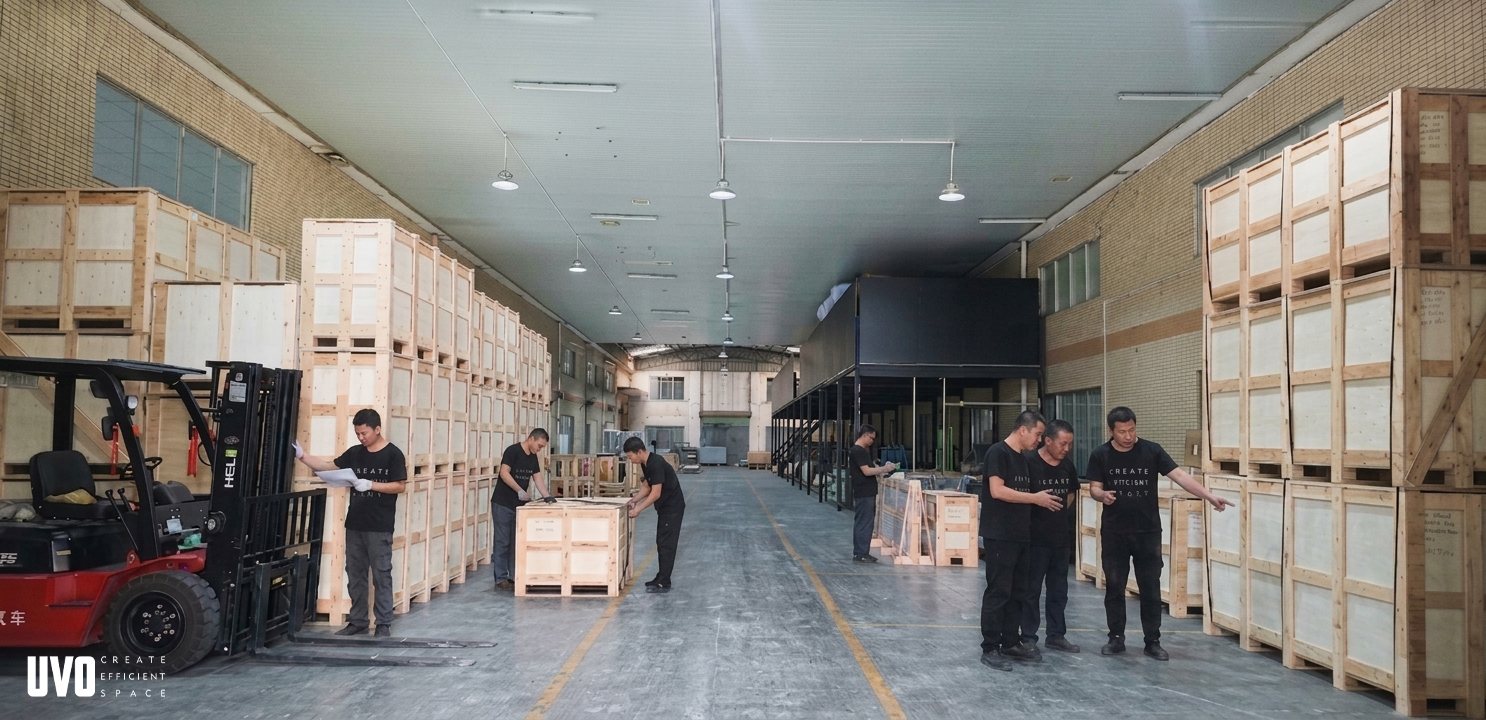
Finished pods in the UVO industrial park storage area. Production capacity is 500–600 units per month, with 100% testing.
Where the pods are built and how they are supported
UVO operates a 5000 m² factory with 70 employees, a 10-person R&D team, proprietary factory production with OEM capability, and customization on size. Export accounts for 70% of output, with global markets served. Quality control is 100% test per unit. After-sales support is delivered through an installation manual, an installation video, remote technical support and on-site guidance.
For a distributor or a project buyer, those facts matter more than a brochure. A five-to-six-week customized lead time and a one-unit MOQ are the two numbers that determine whether a pilot installation is realistic before a full floor is committed.
FAQ
Are UVO acoustic phone booths CE compliant for the EU market?
Yes. UVO acoustic pods hold CE electrical safety certification issued by UDEM under certificate number M.2025.206.C119277, valid until 2030-04-17. The certificate cites EN 62368, EN 50032, EN 60100-3-2 and EN 60100-3-3, and its scope covers the Phone, Solo, Relax, Cowork, Talk, Talk Plus, Meeting, Meeting Plus, Conference, Mini, 3XS, 2XS, XS, S and M models. CE in this scope addresses electrical safety, not acoustic performance; acoustic performance is stated separately as Sound Insulation Class A or Class B by model. For Canada, the MO BOX - Phone, Q ROOM - 3XS and R POD - Mini are covered by SGS NA certificate SGSNA/26/GZ/00129 under CAN/CSA C22.2 No. 61010-1 3rd Ed, valid until 2027-04-17, and interior material emissions are covered by GREENGUARD certificate 354320-410 / 354321-410 / 354322-410 issued by UL under UL 2821 for the North America market.
Can one Chinese acoustic pod manufacturer supply both single-person phone booths and multi-person meeting pods?
UVO supplies three pod families — MO BOX, Q ROOM and R POD — built on a shared construction system of aluminium alloy frame, steel ceiling base and exterior wall panels, 11 mm laminated glass and a 25 mm five-layer acoustic interior wall. Configurations range from one-person phone and focus booths to four-to-six-person conference rooms, including barrier-free models. Production is proprietary factory production with OEM capability and size customization, monthly capacity is 500–600 units, the R&D team is 10 people, and every unit is 100% tested. Because the wall logic is shared across the range, a buyer can validate one configuration and apply the same documentation to the rest of the order.
What drives the price band of an acoustic phone booth?
Price is driven by configuration rather than by brand alone. The variables that move it are occupancy, number of ventilation fans (each rated at 90 m³/h), glazing and acoustic interior wall specification, acoustic class, whether the model is barrier-free, whether size is customized, and how many market certifications the destination project requires. For budget anchoring, one European supplier publishes list prices from €3,990 for a one-person model to €9,990 for a four-person model, excluding VAT; those are that supplier's listed prices and exclude delivery, installation and taxes, so they are a starting reference rather than a market benchmark. UVO does not publish list prices, and quotations are prepared per configuration.
Can a buyer validate a single unit before committing to a full rollout?
The minimum order quantity is 1 unit, so a single-unit validation order is feasible before a floor-wide commitment. A practical validation covers four checks: confirming the acoustic class statement for the exact model, measuring delivered airflow against the fans × 90 m³/h figure, running a light-leak test on the closed door to confirm door alignment, and confirming that the certificate for the destination market lists the model being installed and remains valid through the installation date. Standard lead time for a single unit is 3–4 weeks.
What is the production and delivery lead time?
Standard lead time is 3–4 weeks; customized configurations take 5–6 weeks. Monthly production capacity is 500–600 units, which is what makes a 60-unit open-office deployment deliverable over a six-month programme, as in the Russia reference installation. Every unit is 100% tested before shipment, and the after-sales package includes an installation manual, an installation video, remote technical support and on-site guidance — relevant because sound insulation depends on the booth being level with the floor and the uprights being plumb, ideally checked with a laser level at installation.
Conclusion: specify the constraint, then buy the pod
An acoustic phone booth is a simple product with a short list of checkable facts. The sound insulation class must be stated per model, not per brand. The build-up must be given as aluminium alloy frame, steel ceiling base and exterior wall panels, 11 mm laminated glass and a 25 mm five-layer acoustic interior wall. The airflow must be calculable at 90 m³/h per fan against the occupancy you intend. The certificates must match the destination market, list the model you are buying, and stay valid past the installation date.
Everything else — finish, footprint, colour — is a preference that can be settled in a showroom or a sample review. The four constraints cannot. Once they are written into the specification, the comparison becomes short, and the decision becomes defensible to whoever signs the purchase order.
UVO Acoustic Pods' full range, including the Class A Q ROOM - 3XS and the single-fan MO BOX - Phone acoustic phone booth, is documented in the downloadable catalogue and in model-level specification sheets available on request from www.uvoin.com.
Next step: request the model sheet and a configuration quote
Send the occupancy, the destination market and the acoustic class you need, and UVO will return the matching model, the certificate scope for that market, and a configuration-based quotation. Single-unit validation orders are accepted (MOQ 1 unit).
Email: walter@uvo.hk | Tel / WhatsApp: +86 135 7050 2710 | WhatsApp: +852 5748 4105
Catalogue download: UVO product catalogue (PDF)
Company: HongKong UVO international group Co.,LTD | Building 10, Nimble Shangcheng International, Panyu District, Guangzhou, China | www.uvoin.com
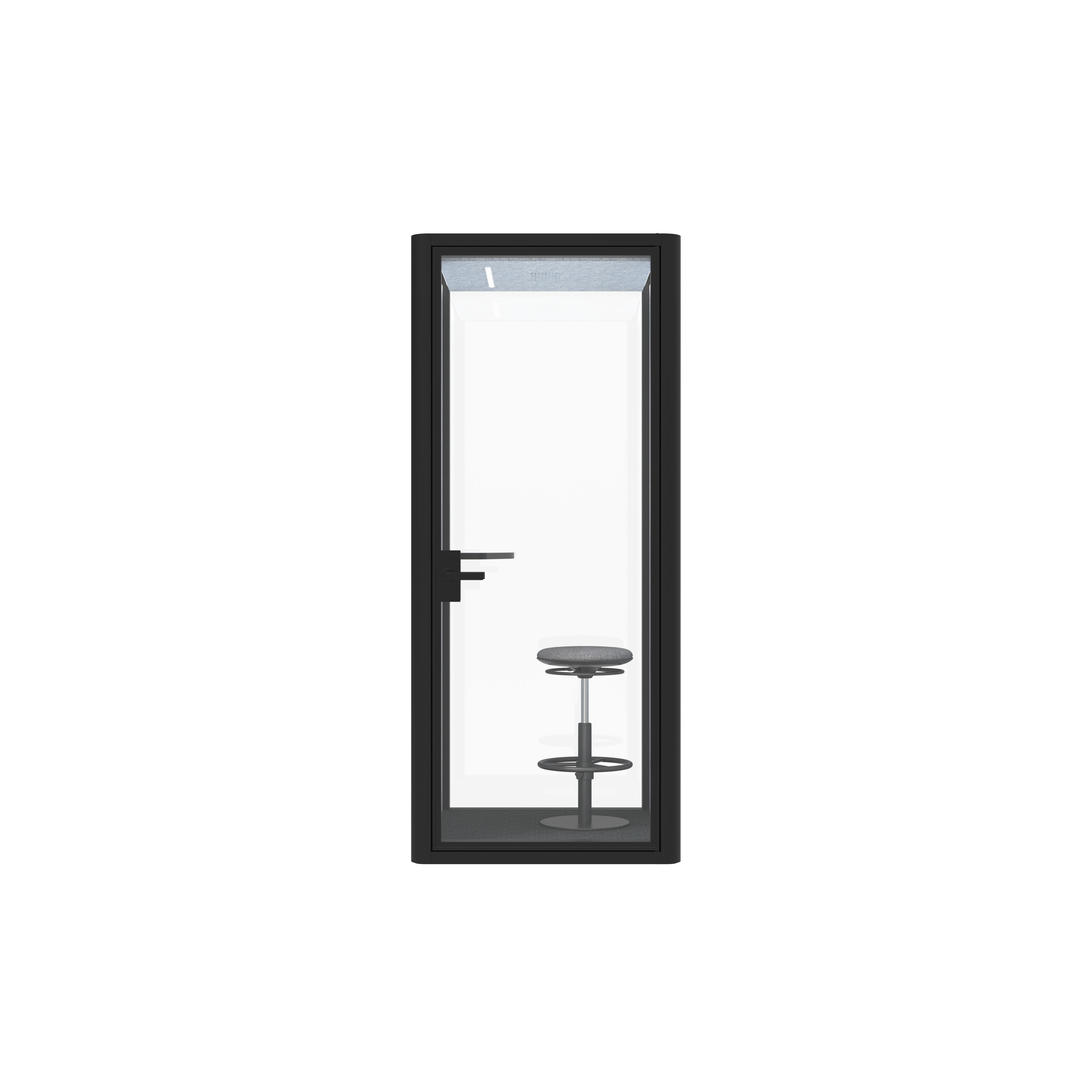
MO BOX - Phone: single-fan acoustic phone booth, Class B, available for single-unit validation.
Have Questions or Need More Details?
Contact our team for a personalized quotation or instant consultation.
Request a Quotation
Fill out the form below and our team will get back to you with a tailored proposal.
WhatsApp Direct Chat
Prefer to chat in real-time? Message us on WhatsApp for instant assistance & quick answers.
- Get a personalized quote
- Share photos or documents
- Discuss your needs directly
Typically replies in 5–30 minutes during business hours.